
App Development
Digital Banking Apps: How to Build Them Faster and More Securely
Digital Banking Apps
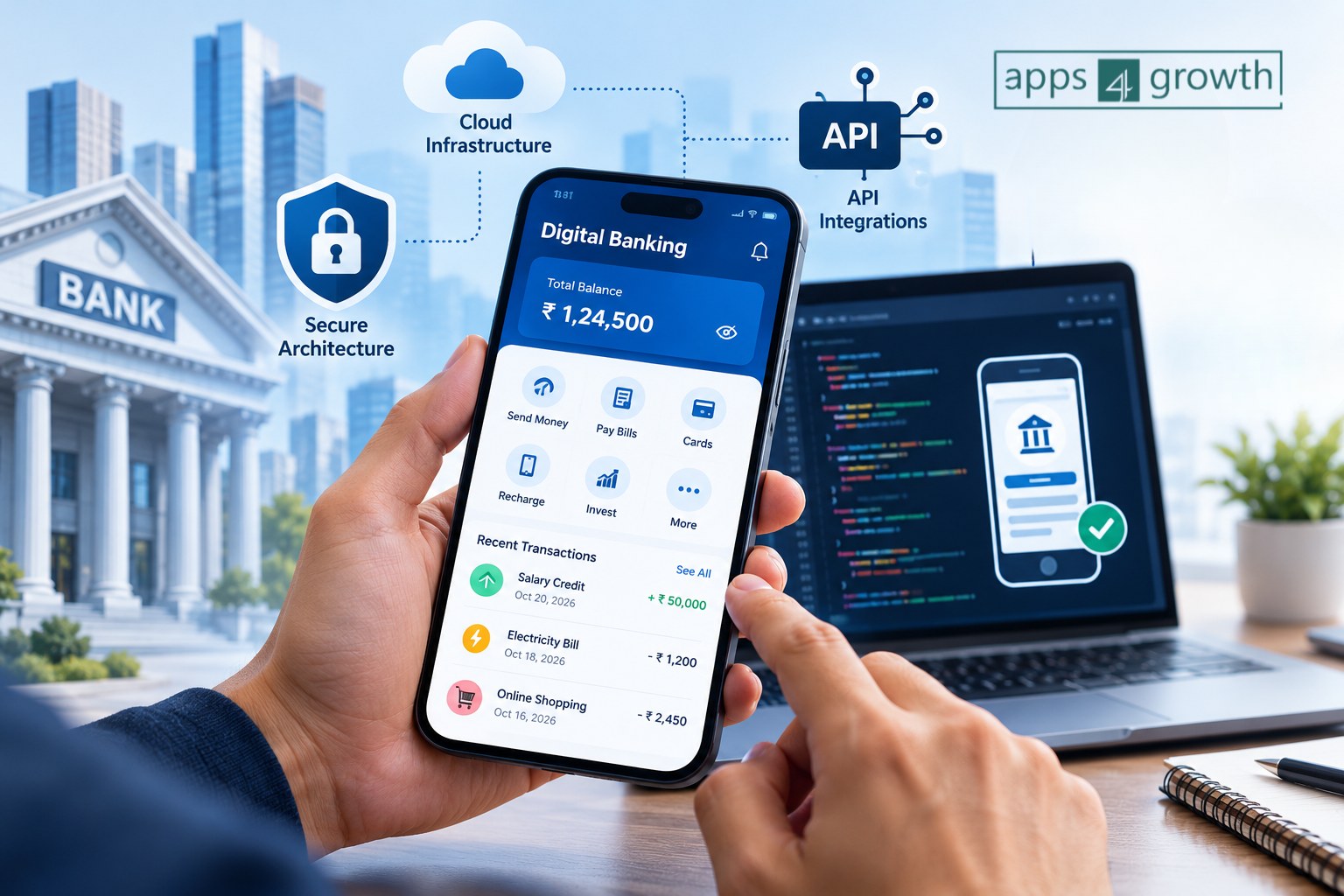
Digital banking has transformed how customers manage money, transfer funds, pay bills, and access financial services. Today, customers expect banking applications to be fast, secure, convenient, and available around the clock. Therefore, financial institutions and fintech startups must find ways to develop high-quality banking apps without unnecessarily extending development timelines.
However, building a digital banking application involves more than designing an attractive interface. Developers must consider security, regulatory compliance, payment integrations, data protection, and system reliability. The right development strategy can help businesses reduce complexity, accelerate delivery, and create a better customer experience.
In this guide, we explain how businesses can build digital banking apps faster while maintaining security, performance, and scalability.
What Is a Digital Banking App?
A digital banking app is a mobile or web application that allows customers to access banking services electronically without visiting a physical branch. These applications enable users to manage accounts, transfer money, monitor transactions, pay bills, and access other financial services.
Common features include:
- Account registration and secure login
- Account balances and transaction history
- Domestic and international money transfers
- Bill payments and mobile recharges
- Debit and credit card management
- Biometric authentication
- Real-time transaction notifications
- Spending insights and financial reports
- Customer support and chatbot assistance
Depending on the business model, a digital banking application may also include loan applications, investment services, digital wallets, and personal finance management tools.
Why Is Faster Digital Banking Apps Development Important?
Launching a banking app quickly can help businesses respond to customer expectations and changing market conditions. Nevertheless, speed should never come at the expense of security or regulatory requirements.
The main benefits of faster development include:
1. Faster time to market: Businesses can introduce essential banking services sooner and begin collecting customer feedback.
2. Lower development costs: Reusable components, automation, and efficient workflows can reduce duplicated effort and unnecessary development work.
3. Improved customer experience: Frequent testing and feedback help teams identify usability problems earlier.
4. Greater competitive advantage: Fintech companies can respond more quickly to emerging customer needs and market opportunities.
5. Easier product improvement: A modular architecture allows teams to introduce new features without rebuilding the entire application.
8 Ways to Build Digital Banking Apps Faster
1. Define the Core Features Before Development
One of the most effective ways to accelerate development is to establish a clear product scope before writing code. Adding too many features at the beginning can increase complexity, cost, and testing requirements.
Instead, identify the essential functions required for the initial release. For example, a minimum viable product (MVP) might include secure registration, account dashboards, transaction history, notifications, and basic money transfers.
Furthermore, separate features into three categories:
- Essential: Required for the initial launch.
- Important: Valuable improvements for upcoming releases.
- Optional: Features that can be introduced after validating customer demand.
This prioritization helps teams concentrate on the most important functionality while keeping the first release manageable.
2. Choose the Right Technology Stack
The technology stack influences development speed, application performance, maintenance, and scalability. Therefore, businesses should select technologies according to their product requirements, available expertise, and security needs.
For example, Flutter or React Native may help teams build cross-platform mobile interfaces using a shared codebase. Native development may be more appropriate when an application requires platform-specific functionality or specialized device integrations.
For backend development, teams can evaluate technologies such as Java, .NET, Node.js, or Python based on their architecture and operational requirements.
However, the newest technology is not necessarily the best choice. A well-supported stack that integrates with banking systems and meets security requirements is often more valuable than an unfamiliar framework selected only for its popularity.
3. Use APIs and Prebuilt Banking Components
Developing every banking feature from scratch can significantly extend project timelines. Instead, businesses can use established APIs and reusable components for suitable functions.
Depending on the market and regulatory environment, these may include:
- Payment gateway integrations
- Identity verification services
- Know Your Customer (KYC) solutions
- Fraud detection systems
- Transaction notification services
- Account aggregation services
- Banking-as-a-Service (BaaS) platforms
For example, an authorized banking or payment partner may provide APIs for specific financial operations. This allows developers to focus on the customer-facing experience instead of rebuilding every underlying capability.
Nevertheless, third-party services must be evaluated for reliability, data handling, regulatory coverage, integration complexity, and vendor dependency. Businesses should also verify whether the provider is authorized to deliver the required services in their target market.
4. Adopt a Modular Application Architecture
A modular architecture divides an application into components with clearly defined responsibilities. As a result, development teams can build, test, and maintain different functions more independently.
A digital banking app might separate its account management, payments, authentication, notifications, and reporting functions into distinct modules.
This approach offers several advantages:
- Developers can work on different features simultaneously.
- Changes to one component are less likely to affect unrelated functions.
- Testing and troubleshooting become more manageable.
- New features can be introduced incrementally.
Microservices can be useful for certain large-scale applications, but they also introduce operational complexity. For smaller projects, a modular monolith may provide a faster and simpler starting point.
Therefore, businesses should choose an architecture that matches their current scale and future requirements rather than adopting unnecessary complexity.
5. Automate Testing and Deployment
Manual testing alone can slow down development, especially when teams frequently update application features. Automated testing helps developers identify defects earlier and verify that existing functionality continues to work after changes.
Useful testing practices include:
- Unit testing for individual components
- Integration testing for APIs and external services
- End-to-end testing for customer journeys
- Security testing for common vulnerabilities
- Performance testing under different workloads
- Regression testing after code changes
In addition, continuous integration and continuous delivery (CI/CD) pipelines can automate code checks, testing, packaging, and deployment tasks.
For banking applications, automated processes should include appropriate approval controls, audit trails, environment separation, and rollback procedures. Production releases involving financial transactions or sensitive data may require additional authorization and monitoring.
6. Integrate Security From the Beginning
Security should be integrated into the development process from the earliest planning stages. Otherwise, treating it as a final checklist can lead to expensive redesigns, delayed launches, and avoidable vulnerabilities. Therefore, addressing security early helps teams reduce risks and build more reliable applications.
Important security measures include:
- Multi-factor authentication where appropriate
- Encryption of sensitive data in transit and at rest
- Secure session management
- Role-based access controls
- API authentication and authorization
- Fraud monitoring and suspicious activity detection
- Secure key and secret management
- Regular vulnerability assessments and penetration testing
Developers should also apply secure coding practices and follow relevant standards, such as the OWASP guidance for web and mobile application security.
Moreover, security requirements should be reviewed throughout development rather than only before launch. This approach helps teams identify problems earlier while protecting customer information and financial transactions.
7. Use Cloud Infrastructure and DevOps Practices
Cloud infrastructure can help development teams provision environments, deploy updates, and scale resources more efficiently. Managed databases, monitoring services, automated backups, and infrastructure-as-code tools can reduce repetitive operational work.
For instance, a development team can create consistent testing environments using automated infrastructure configurations instead of setting up each environment manually.
DevOps practices also encourage collaboration between development, security, and operations teams. Consequently, issues can be identified and resolved earlier in the development lifecycle.
However, cloud adoption does not automatically guarantee security or compliance. Businesses must evaluate data residency, access controls, backup policies, disaster recovery, vendor responsibilities, and applicable financial regulations before selecting an infrastructure provider.
8. Build in Agile Sprints and Gather Feedback
An iterative development process allows teams to deliver smaller, testable improvements instead of waiting until the entire application is complete.
For example, a team might begin with account registration and authentication, then develop account dashboards, followed by transaction history and payment functionality.
At the end of each sprint, stakeholders can review the progress, test features, and provide feedback. This makes it easier to identify unclear requirements and prioritize improvements.
Additionally, usability testing with representative customers can reveal confusing navigation, unnecessary steps, and accessibility issues.
By combining short development cycles with regular feedback, businesses can improve product quality while reducing the risk of discovering major usability problems just before launch.
Key Factors That Affect Digital Banking App Development Time
The time required to develop a banking app depends on its functionality, integrations, regulatory requirements, and technical complexity. The following estimates are illustrative planning ranges, not guaranteed timelines.
| Development scope | Illustrative timeline |
|---|---|
| Basic banking app prototype | 4–8 weeks |
| MVP with essential banking features | 3–6 months |
| More comprehensive digital banking app | 6–12 months or longer |
| Complex banking platform with extensive integrations | 9–18 months or longer |
Actual timelines may vary considerably. Moreover, a prototype is not equivalent to a production-ready banking application. Additionally, an MVP that handles real financial transactions may require substantial compliance checks, security testing, and third-party partner integrations before launch.
The main factors affecting delivery time include:
- Number and complexity of features
- Availability of banking and payment APIs
- Integration with legacy systems
- Security and compliance requirements
- Design and accessibility requirements
- Testing and certification processes
- Team size and technical experience
- External partner approvals
Consequently, businesses should create estimates based on documented requirements and technical discovery rather than relying solely on generic industry timelines.
Common Mistakes That Slow Down Banking App Development
Even experienced teams can experience delays when they overlook important planning and implementation details.
Unclear requirements: Frequent changes to the product scope create rework. Define requirements and acceptance criteria before development begins.
Building everything from scratch: Recreating capabilities that trusted providers already offer can waste time. Evaluate suitable APIs and reusable components.
Ignoring security early: Late-stage security findings can force major architectural changes. Include security reviews throughout development.
Choosing unnecessary complexity: An overly complicated architecture can increase deployment and maintenance effort. Select an approach that fits the project’s actual needs.
Insufficient testing: Defects discovered late can delay launch and damage customer trust. Automate suitable tests and include performance and security validation.
Depending on one external provider: Provider outages, changing API requirements, and integration problems can affect delivery. Assess dependencies and prepare appropriate fallback plans.
How Apps4Growth Can Help Businesses Accelerate Development
Businesses looking to launch digital financial products need a development approach that balances speed, security, and long-term maintainability.
Apps4Growth can support the broader software development process through solutions such as application development, API integration, workflow automation, and cloud-based system development, depending on the project’s requirements.
A structured development process typically includes:
- Discovery and planning: Identify business objectives, user needs, integrations, and technical requirements.
- Architecture and design: Define application components, data flows, security controls, and user journeys.
- Development and integration: Build essential functionality and connect approved third-party services.
- Testing and validation: Evaluate functionality, performance, security, and usability.
- Deployment and maintenance: Release the application through controlled processes and monitor its performance.
The specific services and delivery timeline should be confirmed against the project’s scope and Apps4Growth’s available capabilities.
Conclusion
Building digital banking apps faster requires more than increasing the number of developers or shortening testing cycles. Businesses need a clear product scope, suitable technology, reusable components, modular architecture, automated testing, and continuous feedback.
At the same time, security, regulatory compliance, and transaction reliability must remain central to every development decision. By prioritizing essential features and improving collaboration across development and operations, businesses can reduce unnecessary delays and create a stronger foundation for future growth.
Ultimately, the best approach is to deliver the right functionality efficiently while ensuring that customers can trust the application with their financial information.
Frequently Asked Questions (FAQs)
1. How long does it take to build a digital banking app?
A basic prototype may take several weeks, while an MVP can take three to six months. More comprehensive banking applications may require six months to over a year, depending on integrations, security requirements, compliance reviews, and feature complexity.
2. Which technologies are used to develop digital banking apps?
Common options include Flutter and React Native for cross-platform mobile interfaces, while Java or .NET can support backend systems. Additionally, cloud infrastructure provides hosting and scalability, whereas APIs enable integration with banking and payment services. However, the most suitable technology stack depends on the project’s requirements, security needs, budget, and long-term goals. Therefore, businesses should evaluate these factors carefully before making a final decision.
3. Can businesses use APIs to develop banking apps faster?
Yes. APIs can provide access to services such as payments, identity verification, notifications, and account information. However, businesses must evaluate provider authorization, security, reliability, integration requirements, and regulatory obligations.
4. How can businesses reduce digital banking app development costs?
Businesses can prioritize an MVP, reuse suitable components, automate testing, select an appropriate architecture, and avoid unnecessary features. Early security and integration planning can also reduce expensive rework.
5. What security features should a digital banking app include?
Depending on the application, important controls include strong authentication, encryption, secure API access, session management, fraud monitoring, audit logging, and regular security testing. The final requirements depend on the services offered and applicable regulations.
6. Is cloud infrastructure suitable for digital banking applications?
Cloud infrastructure can support scalability, monitoring, and automated deployment. However, businesses must assess data protection, regulatory requirements, data residency, access controls, disaster recovery, and the responsibilities of each service provider before deployment.
Furthermore, businesses should plan development timelines by evaluating project requirements, technical complexity, and available resources. For example, integrating payment gateways or third-party banking services may require additional testing and approvals. Therefore, involving security experts and integration partners early can help teams identify potential delays and allocate resources more effectively. As a result, businesses can launch reliable digital banking apps with fewer unexpected disruptions.