
Artificial Intelligence
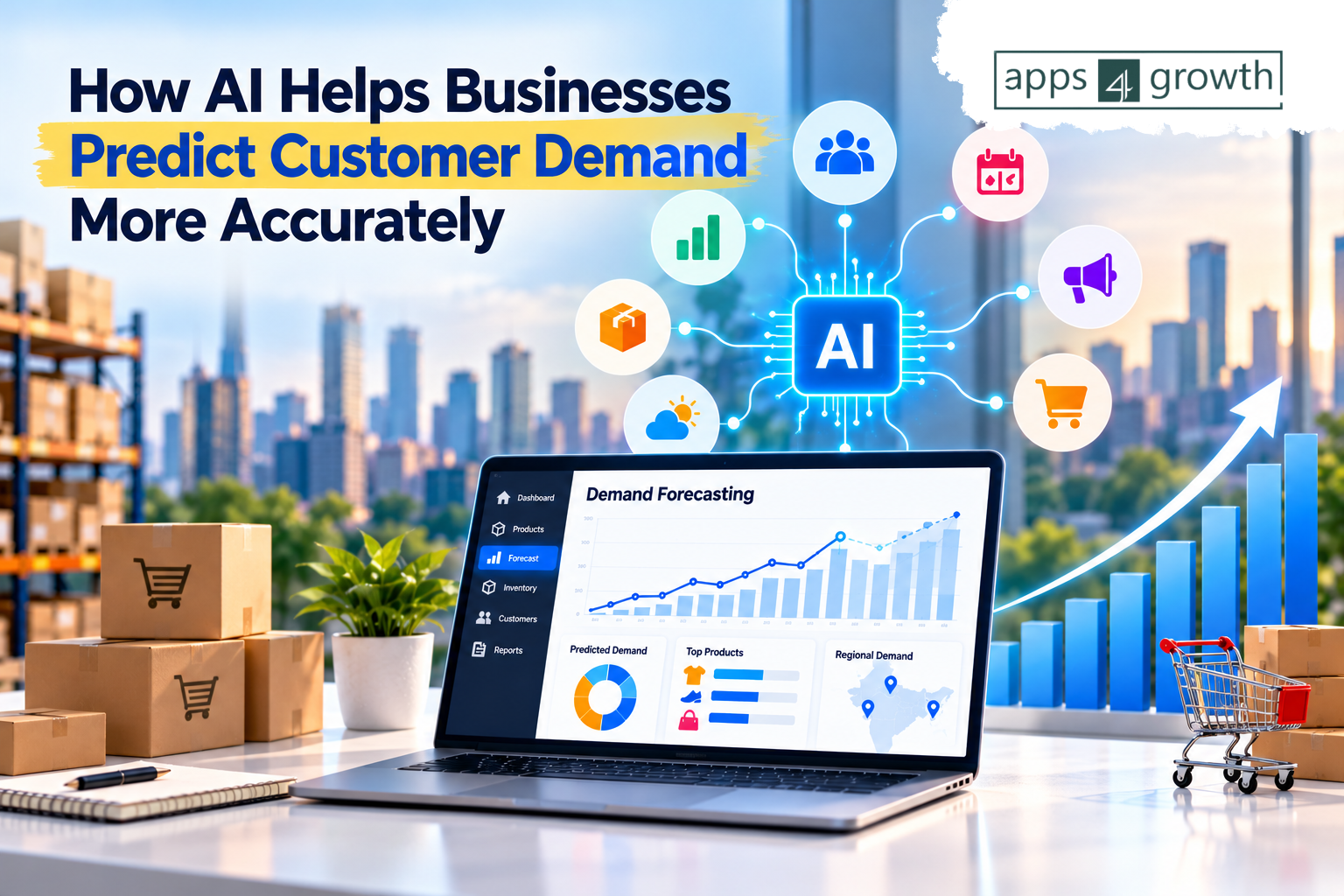
How AI Helps Businesses Predict Customer Demand More Accurately
AI Helps Predict Customer Demand
In today’s competitive business environment, understanding what customers want—and when they want it—is essential for growth. However, changing buying habits, seasonal trends, market competition, and unexpected events can make demand forecasting challenging. Traditional forecasting methods often rely on historical averages and manual analysis, which may not capture these changes quickly enough.
This is where artificial intelligence (AI) in demand forecasting can help. By analyzing large volumes of data, identifying patterns, and updating predictions as new information becomes available, AI helps businesses make more informed decisions about inventory, production, staffing, and marketing.
In this article, we explore how AI improves customer demand prediction, its key benefits, practical applications, and the steps businesses can take to implement it effectively.
What Is AI-Powered Demand Forecasting?
AI-powered demand forecasting uses technologies such as machine learning, predictive analytics, and statistical modeling to estimate future customer demand. These systems analyze historical sales, customer behavior, seasonal patterns, pricing changes, promotional activity, and other relevant factors to identify signals that may influence future purchases.
Unlike a basic forecast that relies mainly on past sales averages, an AI-based model can learn from relationships between different variables. For example, it may identify that demand for a product increases during certain holidays, responds to discounts, or varies by region and customer segment.
However, AI predictions are not guaranteed to be correct. Their accuracy depends on data quality, the suitability of the model, and how well the system accounts for changing market conditions.
Why Is Predicting Customer Demand Important?
Accurate demand forecasting helps businesses balance customer expectations with operational costs. If a company underestimates demand, popular products may run out of stock. On the other hand, overestimating demand can lead to excess inventory, higher storage costs, and wasted resources.
Therefore, businesses need reliable forecasts to make decisions such as:
- How much stock should be ordered?
- Which products are likely to sell faster?
- When should production increase or decrease?
- Which customer segments may respond to a campaign?
- How many employees or delivery resources will be required?
- Where should inventory be allocated across different locations?
By answering these questions more effectively, businesses can improve planning and respond to customer needs with greater confidence.
How AI Helps Businesses Predict Customer Demand
1. Analyzes Large Volumes of Customer Data
AI can process data from multiple sources, including sales records, customer relationship management (CRM) systems, e-commerce platforms, loyalty programs, and customer service interactions.
As a result, businesses can gain a broader understanding of purchasing behavior rather than relying on a single data source. For instance, an online retailer may combine previous orders, product views, abandoned carts, and seasonal sales patterns to estimate demand for different product categories.
Nevertheless, businesses should use customer data responsibly and comply with applicable privacy and data protection requirements.
2. Identifies Hidden Patterns and Trends
Machine learning models can uncover relationships that may be difficult to identify through manual analysis. These patterns might include regional buying preferences, changes in repeat-purchase behavior, or connections between product demand and promotional campaigns.
For example, a retailer might discover that certain products sell more frequently when purchased alongside another item. This insight can support inventory planning, product bundling, and cross-selling strategies.
Moreover, AI models can be retrained as new data becomes available, helping forecasts adapt to evolving customer behavior.
3. Accounts for Seasonality and External Factors
Customer demand can change because of festivals, weather, economic conditions, local events, competitor activity, and broader market trends. AI forecasting systems can incorporate relevant external variables when reliable data is available.
For example, a clothing business may anticipate higher demand for winter products during colder periods. Similarly, a grocery retailer may plan for increased demand for selected items around major festivals.
However, external factors should be chosen carefully. Including irrelevant or unreliable data can reduce forecast quality instead of improving it.
4. Improves Inventory and Stock Planning
One of the most practical uses of AI forecasting is inventory optimization. By estimating future demand at the product, location, or time-period level, businesses can make better decisions about replenishment and stock allocation.
For example, a distributor may use demand predictions to determine which products need restocking first and which locations require additional inventory. This can help reduce stockouts while limiting unnecessary purchases.
When connected with inventory management or enterprise resource planning (ERP) software, forecasting insights can also support replenishment workflows. Still, purchase orders and stock movements should follow appropriate business rules and human oversight.
5. Supports Personalized Marketing
AI can help businesses estimate which products or offers may appeal to different customer segments. By analyzing purchase history, browsing patterns, and campaign responses, businesses can identify potential customer interests and plan more relevant marketing activities.
For example, an e-commerce company may anticipate renewed interest in a product category among customers who previously purchased related items. Marketing teams can then tailor campaigns, product recommendations, or promotional timing accordingly.
Importantly, predicting demand for a customer segment is not the same as knowing an individual’s future actions. Businesses should treat these predictions as estimates rather than certainties.
6. Enables Faster Forecast Updates
Traditional forecasts may be updated at fixed intervals, such as monthly or quarterly. AI-supported systems can refresh estimates more frequently when new sales, inventory, or market data arrives.
Consequently, businesses can respond sooner to unexpected demand spikes, declining sales, supply disruptions, or successful promotions.
For example, if a product begins selling much faster than expected, an updated forecast can alert the operations team to review inventory levels and replenishment plans before shortages become severe.
7. Connects Demand Forecasting With Business Operations
Demand predictions become more valuable when they inform decisions across departments. Integrating forecasting tools with CRM, ERP, supply chain, inventory, and business intelligence systems can give teams a more consistent view of expected demand.
As a result, sales teams can coordinate with operations, procurement teams can plan purchasing, and marketing teams can align promotions with product availability.
This connected approach helps businesses move from simply predicting demand to using forecasts in everyday decision-making.
Key Benefits of AI in Demand Forecasting
AI-based demand forecasting can offer several business advantages when implemented with suitable data, processes, and performance monitoring.
- Better forecasting accuracy: Models can identify complex patterns and incorporate multiple relevant variables.
- Lower inventory costs: Improved estimates can help reduce excess stock and unnecessary storage expenses.
- Fewer stockouts: Businesses can identify potential shortages earlier and review replenishment plans.
- Improved customer satisfaction: Products and services are more likely to be available when customers need them.
- Smarter marketing decisions: Demand estimates can support campaign planning and product promotions.
- More efficient resource allocation: Businesses can plan production, staffing, transportation, and purchasing around expected demand.
- Faster decision-making: Updated forecasts provide teams with timely insights when conditions change.
These benefits are not automatic. Companies should measure actual results against a reliable baseline to understand whether the forecasting system is delivering value.
Real-World Applications of AI Demand Forecasting
AI demand forecasting can support a range of industries, although the data and business objectives differ by sector.
Retail and E-commerce
Retailers can forecast product-level demand across stores, websites, and customer segments. These estimates can support inventory replenishment, seasonal planning, promotions, and warehouse allocation.
For example, an online store can use historical sales and current purchasing trends to estimate which products may require additional stock before a major sale.
Manufacturing
Manufacturers can use demand forecasts to plan raw-material purchases, production schedules, and capacity requirements. Better estimates can help reduce the risk of producing too much or too little.
Furthermore, connecting demand forecasting with production planning can help teams coordinate material availability with expected orders.
Food and Beverage
Restaurants, supermarkets, and food distributors can use forecasting to estimate demand for ingredients and finished products. This is particularly useful for businesses dealing with perishable goods.
For instance, a restaurant may combine historical orders, day-of-week trends, reservations, and local events to plan ingredient purchases and staffing.
Logistics and Distribution
Logistics providers and distributors can estimate shipment volumes, regional demand, and warehouse requirements. These forecasts can support capacity planning and resource allocation.
In addition, businesses may use demand projections alongside route optimization and inventory data to coordinate deliveries more efficiently.
Banking and Financial Services
Financial institutions can use predictive analytics to estimate demand for certain services, understand customer engagement patterns, and plan service capacity. Appropriate governance is important, especially when forecasts influence customer eligibility, pricing, or other consequential decisions.
AI Demand Forecasting vs. Traditional Forecasting
| Factor | Traditional Forecasting | AI-Powered Forecasting |
|---|---|---|
| Data analysis | Often uses historical reports and selected variables | Can analyze multiple data sources and complex relationships |
| Pattern detection | Relies more on predefined rules and manual analysis | Can learn patterns from data |
| Forecast updates | Often scheduled periodically | Can update more frequently when data is available |
| External factors | May be added manually | Can incorporate relevant external data |
| Personalization | Often uses broad product or market averages | Can support product-, region-, or segment-level forecasts |
| Human involvement | Analysts build and adjust forecasts | Human oversight remains important for model selection and decisions |
AI does not make traditional forecasting methods obsolete. In many cases, statistical techniques and human expertise remain valuable, while machine learning adds flexibility for more complex forecasting problems.
How to Implement AI Demand Forecasting in Your Business
Businesses do not need to automate every forecasting process at once. A focused implementation can help them test value before expanding to additional products or departments.
Step 1: Define a Clear Business Objective
Begin by identifying the problem you want to solve. This could involve reducing stockouts, improving purchasing plans, managing seasonal demand, or increasing forecast accuracy for a specific product category.
A clear objective makes it easier to select the right data, technology, and success metrics.
Step 2: Collect and Prepare Reliable Data
Gather relevant information from sales systems, inventory records, CRM platforms, order histories, and other useful sources. Then check for missing values, duplicate records, inconsistent product codes, and outdated information.
Because forecast quality depends heavily on input data, preparation should be treated as a core part of the project rather than an afterthought.
Step 3: Choose the Right Forecasting Approach
Select a forecasting method based on the business problem, available data, forecast horizon, and level of detail required. Some businesses may benefit from established statistical models, while others may need machine learning to handle complex relationships.
The most sophisticated model is not always the best choice. A simpler model that performs consistently may be more useful than a complex system that is difficult to maintain.
Step 4: Integrate Relevant Business Systems
Connect forecasting tools to the systems that hold the necessary information. Depending on the business, this could include ERP, CRM, inventory management, e-commerce, and business intelligence platforms.
Integration helps teams access updated insights and reduces the need to transfer information manually between disconnected systems.
Step 5: Test Forecasts Against Actual Results
Before relying on predictions for major decisions, test the model using historical periods that were not used to train it. Compare its estimates with actual demand and check performance across different products, locations, and time periods.
Useful evaluation measures include mean absolute error (MAE), mean absolute percentage error (MAPE), and weighted absolute percentage error (WAPE). Each metric has limitations, so businesses should choose measures suited to their data and decision-making needs.
Step 6: Monitor and Improve Performance
Demand patterns change over time. Therefore, businesses should monitor forecast errors, investigate major deviations, and retrain or adjust models when necessary.
It is also important to establish clear ownership. Teams should know who reviews forecasts, who approves operational changes, and what actions to take when predictions conflict with business experience.
Challenges Businesses Should Consider
Although AI offers valuable forecasting capabilities, implementation can present several challenges.
Poor data quality: Incomplete or inconsistent records can lead to unreliable forecasts. Businesses should establish data validation and maintenance processes.
Changing market conditions: Unexpected events can make historical patterns less useful. Models should be monitored and updated as conditions evolve.
Integration complexity: Older systems may not easily connect with modern forecasting tools. A phased integration plan can help reduce disruption.
Cost and technical expertise: Software, infrastructure, and specialist skills can require investment. Businesses should compare these costs with measurable operational benefits.
Lack of transparency: Some models are difficult to interpret. Where possible, teams should use explainable methods and provide users with clear information about key forecasting factors.
Overreliance on predictions: Forecasts are estimates, not guarantees. Human judgment remains necessary for unusual situations, strategic decisions, and cases where the cost of error is high.
How Apps4Growth Can Help Businesses Use AI More Effectively
Businesses that want to improve demand forecasting often need more than an AI model. They may also need reliable data pipelines, connected business applications, custom software, dashboards, and automated workflows.
Apps4Growth helps businesses explore digital solutions that align with their operational needs. Depending on project requirements, a business may benefit from integrating existing systems, automating data flows, developing custom applications, or creating reporting tools that make forecasting insights easier to use.
To get started, businesses should identify a specific forecasting challenge, assess the data already available, and define how success will be measured.
Explore digital solutions at Apps4Growth to learn more about building connected, technology-driven business processes.
Conclusion
AI is changing how businesses understand customer demand by helping them analyze historical sales, identify purchasing patterns, account for relevant external factors, and update forecasts as conditions change.
When combined with reliable data, appropriate technology, and human oversight, AI-powered demand forecasting can support better inventory planning, more informed marketing, improved resource allocation, and stronger customer experiences.
The key is to start with a clear business problem, test forecasts against actual outcomes, and continuously improve the process. With this approach, businesses can turn demand predictions into practical decisions that support sustainable growth.
Frequently Asked Questions (FAQs)
1. How does AI predict customer demand?
AI analyzes historical sales, customer behavior, seasonal patterns, pricing, promotions, and other relevant variables to estimate future demand. Machine learning models can identify relationships in the data and update forecasts when new information becomes available.
2. Is AI demand forecasting more accurate than traditional forecasting?
AI can improve forecasting accuracy when demand patterns are complex and suitable data is available. However, results depend on data quality, model selection, and changing market conditions. Traditional statistical methods can also perform well for many business problems.
3. Which industries benefit from AI demand forecasting?
Retail, e-commerce, manufacturing, food and beverage, logistics, distribution, and financial services can all benefit. The value depends on how well the forecasting approach matches each industry’s data and operational requirements.
4. What data is required for AI demand forecasting?
Common inputs include historical sales, orders, inventory levels, prices, promotions, seasonality, and product information. Depending on the business, external data such as weather or local events may also be useful.
5. Can small businesses use AI for demand forecasting?
Yes. Small businesses can begin with forecasting features available in existing inventory, analytics, or business management software. They can expand to more advanced solutions as their data, budget, and requirements grow.
6. How can businesses measure demand forecasting accuracy?
Businesses can compare predicted demand with actual sales using measures such as MAE, MAPE, or WAPE. They should also track business outcomes such as stockouts, excess inventory, waste, and forecast-related costs to determine whether the system is useful.