
Blog
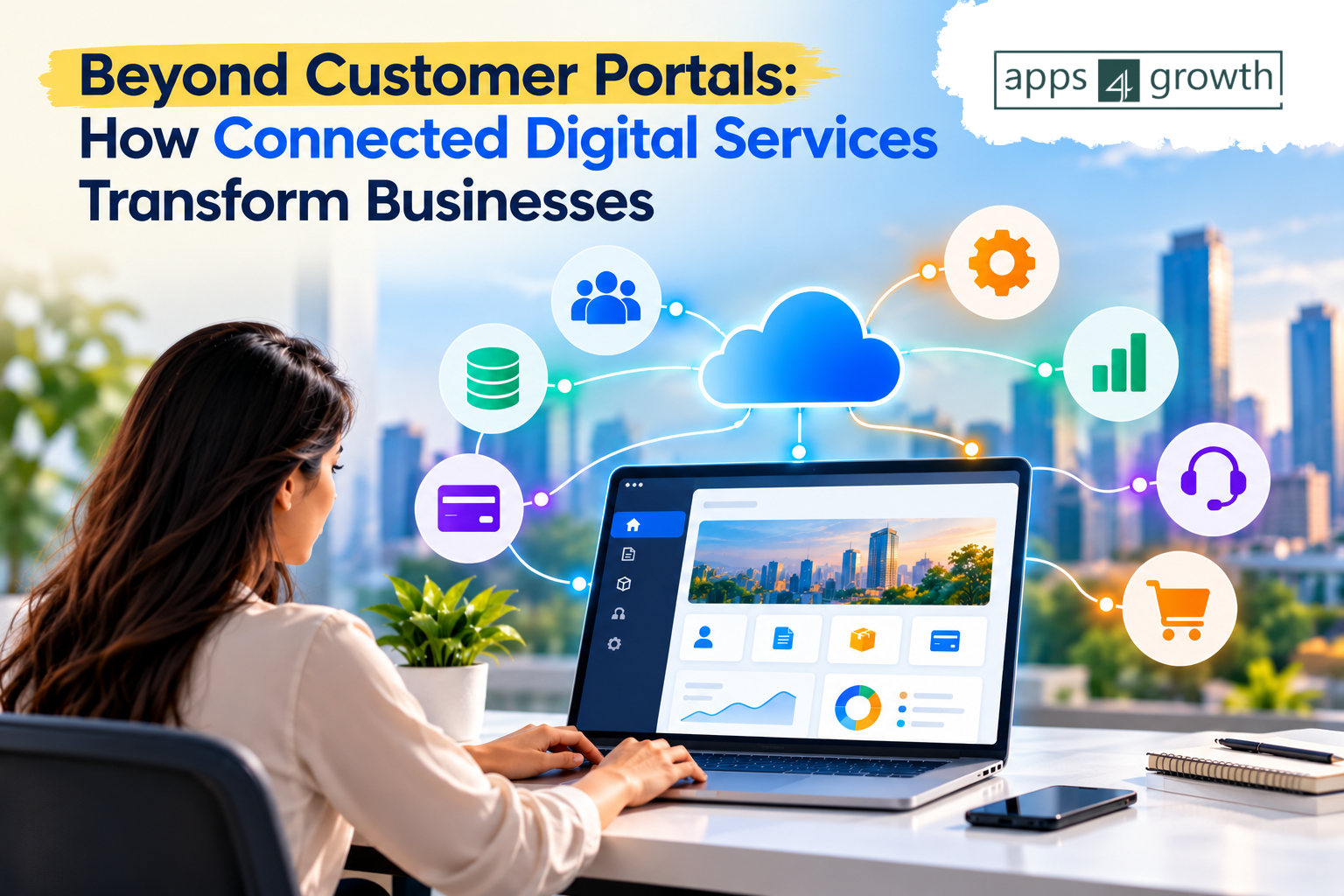
Beyond Customer Portals: How Connected Digital Services Transform Businesses
Customer portal development has become an important part of digital transformation, helping businesses provide customers with convenient access to services, information, and support. However, modern customers expect more than a standalone portal. They want connected digital experiences that allow them to manage accounts, track orders, make payments, access support, and communicate with businesses through a single, seamless journey.
Traditionally, customer portals have focused on specific tasks, such as viewing invoices or submitting support requests. However, disconnected systems can make these tasks frustrating. For example, customers may need to log in to multiple platforms to check an order, update their personal information, or resolve an issue.
Therefore, businesses are moving beyond traditional portals toward connected digital services that integrate applications, data, and workflows. Moreover, technologies such as application programming interfaces (APIs), cloud computing, artificial intelligence (AI), and business process automation are making these experiences more efficient and personalized.
In this article, we explore how connected digital services work, their key benefits, practical use cases, implementation challenges, and the role they play in transforming modern businesses.
What Are Customer Portals and Connected Digital Services?
A customer portal is a secure digital platform that allows customers to access specific business services online. Depending on the organization, it may provide account information, order tracking, payment options, support requests, documents, and other self-service features.
For example, an e-commerce customer portal may allow users to view previous orders, track deliveries, and request returns. Similarly, a banking portal may provide access to account statements, transactions, and service requests.
Connected digital services go a step further. Instead of operating as an isolated platform, they connect customer-facing applications with internal business systems, databases, payment gateways, customer relationship management (CRM) software, and other digital tools.
As a result, customers can complete multiple tasks without repeatedly switching between disconnected platforms.
Customer Portals vs. Connected Digital Services
| Feature | Traditional customer portal | Connected digital services |
|---|---|---|
| Primary purpose | Provides access to specific services | Connects multiple services and workflows |
| Data access | May rely on limited or separate data sources | Can combine data from integrated systems |
| Customer experience | Often focused on individual tasks | Supports connected customer journeys |
| Automation | Usually limited to selected functions | Can automate workflows across systems |
| Personalization | Based on available portal data | Can use connected customer and interaction data |
| Scalability | Depends on the portal architecture | Can expand through modular services and integrations |
However, a traditional portal is not necessarily outdated. When designed with suitable integrations and architecture, it can become an important part of a connected digital ecosystem.
Why Businesses Need More Than Traditional Customer Portals
Customer expectations are changing as digital services become more accessible. People increasingly expect businesses to provide fast responses, consistent information, and convenient self-service options.
Nevertheless, a standalone portal may not meet these expectations if it cannot communicate with other business applications.
For example, a customer might submit a service request through a portal but still need to contact support separately to check its progress. Similarly, an online order system may display incomplete delivery information if it is not connected to the logistics platform.
These gaps can create unnecessary work for customers and employees. Therefore, businesses need to connect digital services across their operations.
Connected services can help organizations:
- Reduce repeated data entry across applications.
- Provide consistent information across digital channels.
- Automate routine customer requests.
- Improve communication between departments.
- Offer more personalized customer experiences.
- Increase visibility into customer interactions.
- Simplify complex service journeys.
Moreover, connected digital services help businesses respond more effectively as customer needs and operational requirements evolve.
Key Benefits of Connected Digital Services
1. A Seamless Customer Experience
One of the main advantages of connected digital services is a more consistent customer journey.
Instead of requiring customers to use separate systems for different tasks, businesses can connect relevant services through a unified interface. For example, customers may be able to view an order, download an invoice, make a payment, and raise a support request through the same platform.
Furthermore, integrated data can reduce the need for customers to provide the same information repeatedly.
As a result, customers can complete tasks more conveniently, while businesses can reduce friction across their digital services.
2. Improved Operational Efficiency
Disconnected systems often force employees to transfer information manually between applications. Consequently, routine tasks can take longer and become more prone to errors.
Connected digital services can automate data exchange and coordinate workflows across systems. For instance, when a customer submits a request, the portal may automatically create a support ticket in the CRM system and notify the appropriate team.
Additionally, employees can access relevant information from connected applications rather than searching through separate databases.
Therefore, businesses can reduce repetitive administrative work and allow employees to focus on more complex responsibilities.
3. Better Data Visibility and Decision-Making
Customer information is often distributed across CRM platforms, billing systems, support tools, and transaction databases. When these systems operate separately, businesses may struggle to understand the complete customer journey.
However, connected digital services can bring relevant information together through integrations and shared data processes.
For example, a business may analyze customer enquiries alongside purchase history and support interactions to identify recurring problems. Moreover, managers can use this information to improve services, identify operational bottlenecks, and make more informed decisions.
The quality of these insights depends on accurate data, appropriate permissions, and reliable integration.
4. Personalized Customer Interactions
Customers often prefer services that reflect their individual needs and preferences. Connected systems can help businesses deliver more relevant experiences by using authorized customer data.
For instance, an online service platform may display relevant account information, recommend suitable support resources, or provide reminders based on a customer’s activity.
Furthermore, AI-powered tools can help categorize enquiries and suggest relevant responses when sufficient, appropriate data is available.
As a result, businesses can make digital interactions more relevant. However, personalization should respect customer consent, privacy requirements, and data protection policies.
5. Faster Customer Support
Customers expect quick answers when they encounter problems. However, support teams may face delays if they cannot access the information needed to resolve a request.
Connected digital services can link customer portals with help desk software, CRM platforms, knowledge bases, and communication channels.
For example, a support representative may be able to view a customer’s order status, previous interactions, and open service requests from a connected interface.
Additionally, self-service knowledge bases and chatbots can help customers find answers to common questions without waiting for an employee.
Consequently, support teams can manage requests more efficiently while focusing their attention on issues that require human assistance.
6. Greater Scalability and Flexibility
As businesses grow, they often introduce new products, services, and digital channels. However, a tightly connected system with rigid architecture can make expansion difficult.
Connected digital services can use modular components and APIs to allow individual systems to communicate without requiring every application to be rebuilt.
For example, a business may add a new payment provider or integrate a delivery tracking service while retaining its existing customer portal.
Therefore, a well-designed architecture can make it easier to introduce new capabilities and adapt to changing business needs.
7. Stronger Customer Retention
A convenient digital experience can encourage customers to continue using a business’s services. When customers can easily access information, complete transactions, and receive support, they may have fewer reasons to seek alternatives.
Moreover, connected systems can help businesses identify recurring customer issues and respond before they become larger problems.
Although technology alone cannot guarantee customer loyalty, reliable digital services can contribute to a stronger customer relationship.
Common Use Cases of Connected Digital Services
Connected digital services can support a wide range of industries. The exact features depend on the organization’s business model, customer needs, and existing technology infrastructure.
1. E-Commerce and Retail
Retail businesses can connect customer portals with inventory systems, order management platforms, payment gateways, and delivery services.
For example, customers could place orders, check stock availability, track shipments, download invoices, and initiate returns from one interface.
Additionally, integrated systems can provide employees with more consistent order information.
As a result, retailers can improve order visibility and reduce manual coordination between sales, warehouse, and customer support teams.
2. Banking and Financial Services
Financial institutions can connect customer-facing platforms with account services, payment systems, document management, and support workflows.
For example, customers may be able to download statements, update eligible account information, submit service requests, and track application progress online.
Furthermore, secure integrations can help provide consistent information across digital banking channels.
However, financial services require strict attention to authentication, access control, transaction security, and applicable regulatory requirements.
3. Healthcare
Healthcare providers can connect patient portals with appointment scheduling, billing, document access, and communication systems.
For instance, patients may be able to book appointments, receive reminders, access permitted records, and view billing information through a unified platform.
Consequently, connected services can simplify administrative processes and improve access to relevant information.
Nevertheless, healthcare platforms must apply appropriate privacy protections, access permissions, and security controls when handling sensitive patient information.
4. Manufacturing and B2B Services
Manufacturers and business-to-business service providers often manage complex relationships involving orders, contracts, invoices, product information, and technical support.
Connected customer portals can link these activities with enterprise resource planning (ERP), CRM, inventory, and service management systems.
For example, a distributor may check product availability, place a bulk order, download invoices, and monitor delivery status from a single platform.
Moreover, automated notifications can help customers stay informed about order changes and service updates.
5. Real Estate and Property Management
Real estate businesses can use connected digital services to simplify communication between property managers, buyers, tenants, and service teams.
For example, a property portal may provide access to payment records, maintenance requests, property documents, and service updates.
Additionally, integration with CRM systems can help sales teams manage enquiries and follow up with prospective buyers.
As a result, property businesses can improve information access and coordinate customer interactions more effectively.
6. Education and Professional Services
Educational institutions and professional service providers can connect customer or student portals with scheduling, payments, document management, and communication platforms.
For example, students may be able to access course information, download documents, track payments, and submit requests through a connected platform.
Similarly, professional service clients may use a portal to review project updates, exchange documents, and communicate with service teams.
Therefore, connected services can help organizations simplify administrative tasks and improve transparency.
Technologies That Power Connected Digital Services
Several technologies work together to create connected digital experiences. Choosing the right combination depends on the business requirements, existing systems, and expected scale.
1. Application Programming Interfaces (APIs)
APIs allow different software applications to exchange data and request services from one another.
For example, a customer portal may use an API to retrieve order information from an order management system or initiate a payment through a payment provider.
Consequently, APIs can reduce the need for manual data transfer and help businesses connect applications more efficiently.
2. Cloud Computing
Cloud platforms provide infrastructure and services for hosting applications, managing data, and supporting changing workloads.
Moreover, cloud-based systems can help businesses deploy updates, scale selected resources, and connect digital services across different environments.
However, cloud architecture should be selected according to security, compliance, performance, and cost requirements.
3. Customer Relationship Management (CRM)
CRM platforms help businesses organize customer information, sales activities, service requests, and communication history.
When connected to a customer portal, a CRM system can help employees view relevant interactions and manage customer enquiries more consistently.
As a result, businesses can improve coordination between sales, marketing, and customer support teams.
4. Enterprise Resource Planning (ERP)
ERP systems manage core business activities such as finance, procurement, inventory, and operations.
Integrating a customer portal with an ERP platform can allow customers to access relevant order details, invoices, and account information.
Furthermore, it can help reduce discrepancies caused by maintaining the same information in multiple systems.
5. Artificial Intelligence and Automation
AI can support connected digital services through conversational assistants, information retrieval, recommendation systems, and automated classification of customer requests.
Meanwhile, workflow automation can coordinate tasks such as ticket creation, notifications, approvals, and document processing.
For example, when a customer submits a request, an automated workflow could categorize the issue and route it to the appropriate team.
Nevertheless, businesses should validate AI outputs and require human approval for sensitive or high-impact actions.
6. Identity and Access Management
Connected services need reliable ways to authenticate users and control access to information.
Identity and access management solutions can support features such as single sign-on, multifactor authentication, and role-based permissions.
Therefore, businesses can make access more convenient while ensuring that users only receive the permissions appropriate to their roles.
How to Build Connected Digital Services
Building connected digital services requires a clear strategy, appropriate architecture, and careful implementation. The following steps can help businesses plan the process.
Step 1: Identify Customer Needs
First, determine which customer tasks create the most friction. For example, customers may struggle to track orders, access invoices, submit service requests, or receive timely updates.
Additionally, gather feedback from customers and employees to identify gaps in the existing digital experience.
This helps ensure that development efforts focus on genuine business needs rather than unnecessary features.
Step 2: Map the Customer Journey
Next, document how customers interact with your business across websites, portals, mobile applications, email, and support channels.
For example, a typical journey may begin with an enquiry, continue through an order, and end with payment and after-sales support.
By mapping these steps, businesses can identify where disconnected systems create delays or duplicate work.
Step 3: Assess Existing Systems
Before developing new functionality, review the current technology environment, including CRM, ERP, payment, inventory, and customer support systems.
Furthermore, determine which platforms offer APIs, which require custom integration, and where data quality problems may exist.
Consequently, businesses can establish a realistic integration plan and reduce unexpected implementation challenges.
Step 4: Choose the Right Architecture
The architecture should support secure communication, maintainability, and future expansion.
Depending on the requirements, businesses may use API-based integration, modular applications, event-driven workflows, or a combination of these approaches.
However, the most complex architecture is not always the best choice. Instead, select an approach that meets current needs while allowing reasonable future growth.
Step 5: Prioritize Security and Privacy
Security should be considered from the beginning of the project. Important measures may include secure authentication, encryption, access controls, audit logging, and regular security testing.
Additionally, businesses should identify what customer information each service needs and restrict access accordingly.
As a result, organizations can reduce unnecessary exposure of sensitive data and establish more reliable digital services.
Step 6: Develop and Test the Solution
Once the architecture is defined, development teams can build the required interfaces, integrations, and automated workflows.
Furthermore, testing should cover functionality, usability, integration reliability, performance, and security.
For example, teams should verify that order updates remain consistent between the portal and the backend system, even when an integration temporarily fails.
Step 7: Launch, Measure, and Improve
After testing, launch the solution in stages where practical. Then, monitor how customers use the services and whether the system delivers the expected results.
Useful performance indicators may include:
- Customer self-service completion rate.
- Average time to resolve support requests.
- Portal adoption and repeat usage.
- Number of manually processed requests.
- Integration error rate.
- Customer satisfaction scores.
Therefore, ongoing measurement can help businesses identify improvements and prioritize future development.
Challenges in Building Connected Digital Services
Although connected digital services offer several benefits, implementation can introduce technical and operational challenges.
Legacy System Integration
Older systems may lack modern APIs or use outdated data formats. Consequently, connecting them to new applications may require middleware, custom connectors, or phased modernization.
Data Silos and Inconsistency
Different departments may maintain separate versions of customer or transaction data. However, inconsistent information can create confusion and reduce trust.
Therefore, businesses should establish clear data ownership, validation rules, and synchronization processes.
Cybersecurity Risks
Connecting multiple applications can expand the number of potential entry points into business systems. For this reason, organizations should use secure integrations, restrict permissions, monitor access, and regularly review vulnerabilities.
High Initial Investment
Development, integration, testing, and employee training can require significant resources. Nevertheless, businesses can manage this challenge by prioritizing high-value use cases and implementing the solution in phases.
Change Management
Employees may need to adapt to new processes and tools. Additionally, teams must understand their responsibilities when automated workflows change how requests are handled.
Consequently, communication, training, and clear operating procedures are essential for successful adoption.
Best Practices for Successful Digital Services Integration
To build connected digital services that deliver lasting value, businesses should follow these practices:
- Start with clear objectives: Identify specific customer or operational problems before selecting technology.
- Use secure APIs: Apply authentication, authorization, monitoring, and appropriate rate limits to integrations.
- Maintain consistent data: Establish data validation and synchronization procedures across systems.
- Design for users: Keep interfaces simple and make common tasks easy to complete.
- Automate carefully: Automate repetitive, well-defined processes while retaining human review for exceptions.
- Plan for scalability: Choose architecture and infrastructure that can accommodate expected growth.
- Monitor performance: Track service availability, error rates, completion times, and customer feedback.
- Improve continuously: Use measured results to prioritize updates and address emerging problems.
Moreover, businesses should involve relevant stakeholders early so that technical decisions align with customer needs and operational requirements.
How Apps4Growth Can Help Build Connected Digital Services
Apps4Growth helps businesses explore digital solutions designed around their operational needs and growth objectives. Depending on the project scope, relevant services may include custom software development, web and mobile application development, API integration, and business process automation.
For example, a business may need to connect its customer portal with a CRM system, payment gateway, inventory platform, or customer support application. By integrating these systems, organizations can reduce disconnected workflows and provide customers with more consistent access to information.
Furthermore, businesses may need custom dashboards, automated notifications, or tailored digital workflows to support specific customer journeys.
Apps4Growth can help organizations define project requirements, evaluate suitable technical approaches, and plan development around measurable business goals. Additionally, a phased implementation can help businesses test integrations, gather feedback, and improve the solution over time.
To explore available solutions, visit the Apps4Growth website.
Conclusion
Customer portal development remains an important part of digital transformation. However, businesses can create greater value when their portals connect with the systems, data, and workflows that support the entire customer journey.
By integrating CRM, ERP, payment systems, support tools, and other applications, connected digital services can improve self-service, reduce repetitive work, and provide more consistent customer experiences.
Moreover, APIs, cloud computing, AI, and workflow automation give businesses practical ways to connect services and adapt to changing requirements. Nevertheless, success depends on thoughtful architecture, reliable data, strong security, and continuous performance monitoring.
Ultimately, businesses should move beyond isolated digital touchpoints and focus on creating connected services that solve real customer problems. With the right strategy and implementation partner, connected digital services can support operational efficiency, stronger customer relationships, and sustainable business growth.
Frequently Asked Questions (FAQs)
1. What is customer portal development?
Customer portal development is the process of building a secure digital platform where customers can access services, manage accounts, view information, submit requests, and communicate with a business.
2. What are connected digital services?
Connected digital services are applications and workflows that work together by exchanging relevant data. They may connect customer portals with CRM systems, ERP platforms, payment gateways, support tools, and other business applications.
3. How are connected digital services different from traditional customer portals?
Traditional portals may provide access to a limited set of services, whereas connected digital services integrate multiple applications and workflows. Consequently, customers can often complete more tasks through a coordinated digital experience.
4. What technologies are used to build connected digital services?
Common technologies include APIs, cloud computing, CRM and ERP platforms, identity management, AI, and workflow automation. The appropriate combination depends on the business requirements and existing systems.
5. What are the benefits of connected digital services?
Key benefits include improved customer experience, faster service delivery, reduced manual work, better data visibility, more consistent information, and greater flexibility as business needs change.
6. Are connected digital services suitable for small businesses?
Yes. Small businesses can begin by connecting a few essential systems, such as their website, CRM, payment platform, and customer support tools. Additionally, a phased approach can help manage costs and implementation complexity.
7. What challenges can businesses face when integrating digital services?
Common challenges include legacy system integration, inconsistent data, cybersecurity risks, implementation costs, and employee training. Therefore, businesses should establish clear requirements and plan integration, testing, and security from the beginning.
8. How can businesses measure the success of connected digital services?
Businesses can measure portal adoption, self-service completion rates, customer satisfaction, support resolution time, integration reliability, and the reduction in manual tasks. These indicators help determine whether the solution is meeting its intended objectives.