
App Development
Mental Health App Development Process: From Idea to Launch
Mental Health App Development
Digital healthcare is changing how people access mental wellness resources, connect with professionals, and manage their well-being. From mood-tracking applications to online therapy platforms, mental health apps are making digital support more accessible and convenient.
As demand for digital healthcare solutions grows, businesses, healthcare providers, and startups are exploring mental health app development. However, building a successful application involves more than creating an attractive interface. It requires careful planning, user-focused design, secure technology, privacy safeguards, and appropriate regulatory considerations.
Whether you are developing a meditation app, a therapy platform, or an AI-powered mental wellness solution, understanding the development process can help you move from an initial idea to a reliable product.
This guide explains the key stages of mental health app development, including planning, feature selection, technology, security, testing, and launch.
What Is Mental Health App Development?
Mental health app development is the process of designing, building, testing, and maintaining digital applications that support mental wellness or facilitate access to mental healthcare services.
Moreover, depending on their purpose, these applications may help users track moods, practice mindfulness, access educational resources, schedule therapy sessions, communicate with licensed professionals, and monitor personal wellness goals.
Common types of mental health applications include:
- Meditation and mindfulness apps: Offer guided meditation, breathing exercises, and relaxation activities.
- Therapy and counselling apps: Connect users with qualified mental health professionals through chat, audio, or video sessions.
- Mood-tracking apps: Help users record emotions, identify patterns, and review personal wellness trends.
- Mental wellness platforms: Provide educational content, self-care resources, and guided activities.
- AI-powered mental health apps: Use conversational interfaces or personalization features to provide limited, supportive digital experiences.
- Employee mental wellness apps: Help organizations provide wellness resources and support programs to employees.
Each category has different functional, clinical, privacy, and compliance requirements. Therefore, defining the application’s purpose is the first step in the development process.
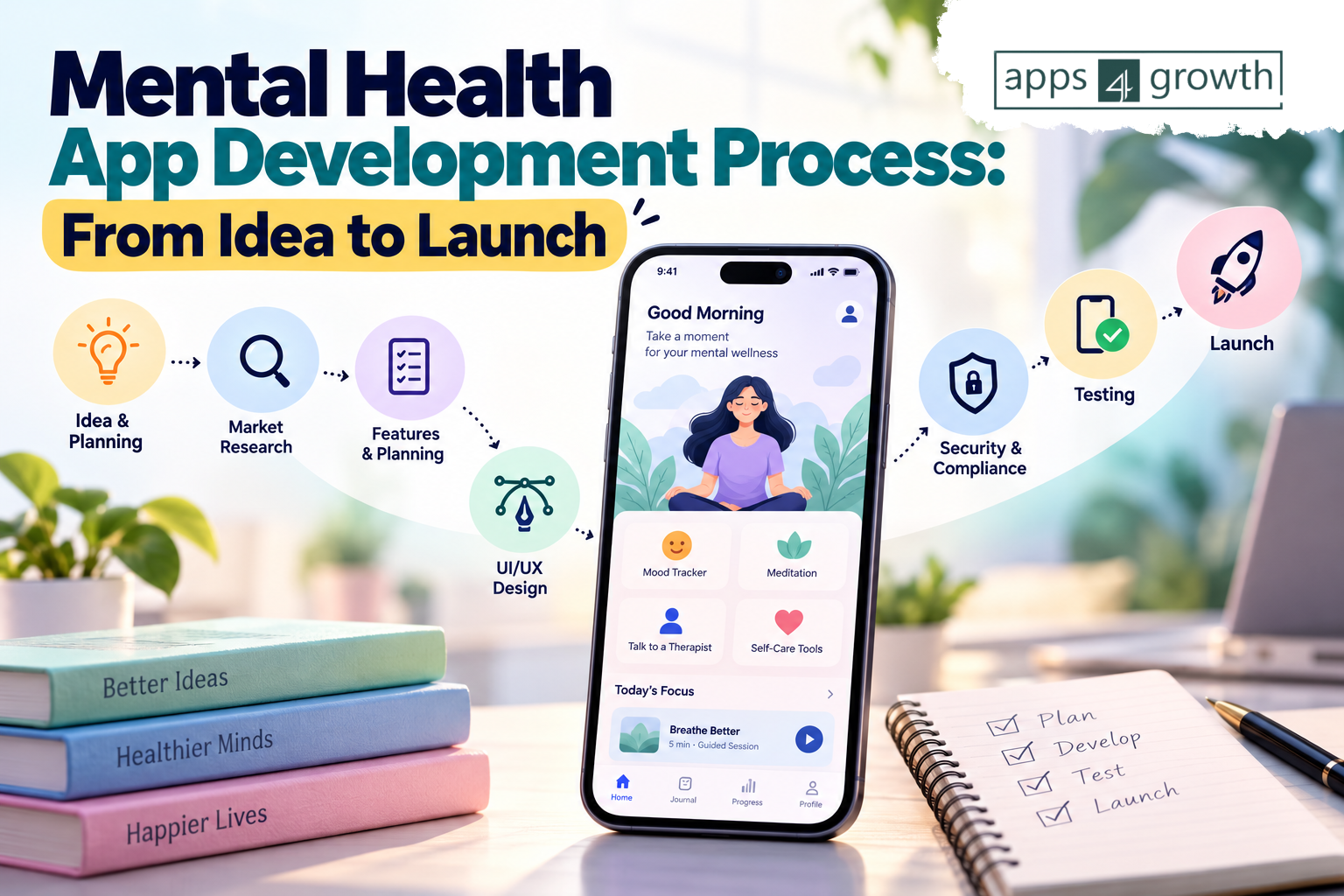
Mental Health App Development Process: Step-by-Step
Building a mental health application requires a structured approach. The following stages help businesses turn an idea into a functional and scalable digital product.
Step 1: Define Your App Idea and Target Audience
Start by identifying the problem your application intends to address. A clear problem statement helps determine the app’s features, audience, technology, and overall development strategy.
For example, your idea might focus on helping users maintain daily wellness routines, connecting individuals with therapists, or providing organizations with employee wellness resources.
Next, define your target audience. Consider factors such as age group, accessibility needs, digital habits, location, and preferred communication methods.
You should also identify whether the application is intended for general wellness or clinical mental healthcare. This distinction matters because an app that provides general mindfulness exercises may have different regulatory obligations from one that diagnoses conditions or recommends treatment.
Key activities:
- Identify the primary problem and intended solution.
- Define target users and their needs.
- Research competing applications.
- Establish the app’s purpose and boundaries.
- Identify potential clinical or healthcare partners.
- Set measurable product objectives.
Step 2: Conduct Market Research and Competitor Analysis
Once the idea is defined, research the market to understand existing solutions and identify opportunities for differentiation.
Study popular applications such as Calm, Headspace, BetterHelp, and Talkspace. Examine their user experience, subscription models, core features, onboarding processes, and service offerings.
Instead of simply copying existing features, identify what users may find difficult or missing. For example, your research might reveal opportunities for multilingual support, easier therapist discovery, improved accessibility, or better privacy controls.
Also examine customer reviews and feedback to understand common complaints, such as complicated registration, limited customization, subscription confusion, or difficulty accessing support.
Key activities:
- Analyze competitor features and pricing.
- Study customer reviews and app ratings.
- Identify underserved user groups.
- Evaluate market demand and business opportunities.
- Define your app’s unique value proposition.
Step 3: Choose the Right Mental Health App Features
Feature selection determines how users interact with your application. However, adding too many features during the initial development stage can increase complexity, cost, and testing requirements.
Start with a minimum viable product (MVP) that addresses the primary user need. Additional capabilities can be introduced after collecting user feedback.
Here are some important features to consider:
| Feature | Purpose |
|---|---|
| User registration and profiles | Allows users to create and manage accounts |
| Mood tracking | Helps users record emotions and review patterns |
| Guided meditation | Provides structured mindfulness activities |
| Journaling | Enables users to record thoughts and reflections |
| Appointment scheduling | Supports booking sessions with professionals |
| Secure messaging | Enables private communication where appropriate |
| Video consultations | Facilitates remote therapy sessions |
| Push notifications | Sends reminders and relevant updates |
| Progress dashboard | Displays user activity and wellness trends |
| Resource library | Provides educational and self-care content |
| Subscription management | Handles paid plans and billing |
| Emergency support information | Helps users locate appropriate crisis resources |
The right feature set depends on the app’s intended purpose. For example, a meditation application may not need video consultations, while a therapy platform may require professional profiles, appointment scheduling, secure communication, and session management.
Step 4: Create a User-Friendly UI/UX Design
Mental health applications should provide a comfortable, accessible, and easy-to-understand experience. Users may access these platforms during stressful or emotionally difficult moments, so confusing navigation and overwhelming interfaces should be avoided.
Begin with wireframes that map the main screens and user journeys. Then create interactive prototypes to evaluate how users move through the application.
Focus on:
- Simple registration and onboarding.
- Clear navigation and readable typography.
- Accessible colors and sufficient contrast.
- Consistent layouts and familiar interface patterns.
- Easy-to-understand privacy and consent settings.
- Customizable notifications.
- Support for accessibility requirements.
User testing is especially important. Feedback from people with different accessibility needs and digital experience levels can reveal usability issues before development begins.
Step 5: Select the Technology Stack
Choosing the right technology stack affects performance, security, scalability, and long-term maintenance.
The selection should depend on your application’s complexity, expected traffic, integration requirements, development budget, and platform strategy.
| Technology area | Possible technologies |
|---|---|
| Mobile app development | Flutter, React Native, Swift, Kotlin |
| Web development | React, Next.js, Angular |
| Backend development | Node.js, Python, Java |
| Database | PostgreSQL, MySQL, MongoDB |
| Cloud infrastructure | AWS, Microsoft Azure, Google Cloud |
| Video communication | WebRTC and suitable video APIs |
| Authentication | OAuth 2.0, OpenID Connect, secure identity services |
| Analytics | Privacy-conscious product analytics tools |
| API integration | REST APIs, GraphQL |
For example, Flutter or React Native may help teams develop applications for both Android and iOS. However, native development may be more appropriate when an app requires specialized platform capabilities.
The final stack should be selected after reviewing security, integration, performance, and compliance requirements.
Step 6: Build the Backend and Integrate APIs
The backend manages the application’s core operations, including user accounts, authentication, data storage, appointment scheduling, notifications, and communication between different services.
A well-designed backend should support reliable data processing and protect sensitive information.
Depending on the app’s functionality, developers may integrate:
- Payment gateways for subscription billing.
- Video conferencing services for online consultations.
- Calendar APIs for appointment scheduling.
- Notification services for reminders.
- Healthcare systems or EHR platforms where appropriate.
- Identity verification services for professional accounts.
- Analytics tools for product performance monitoring.
Furthermore, every integration should be carefully evaluated in terms of data security, permissions, vendor responsibilities, and regulatory suitability. In addition, businesses should never automatically assume that third-party APIs meet healthcare compliance requirements.
Step 7: Implement Data Privacy and Security Measures
Mental health applications may process highly sensitive personal information. Therefore, privacy and security should be considered from the beginning rather than added after development.
Important safeguards include:
Data encryption: Protect sensitive information during transmission and, where appropriate, while stored.
Secure authentication: Use appropriate authentication controls, account protection, and session management.
Access control: Restrict access to personal information based on roles and legitimate business needs.
User consent: Explain what information is collected, why it is required, and how it will be used.
Data minimization: Collect only the information necessary to provide the application’s services.
Secure backups: Establish protected backup and recovery procedures.
Audit logs: Record relevant access and administrative activities to support security monitoring.
Incident response: Prepare procedures for investigating, containing, and reporting security incidents where required.
Businesses should also establish clear data retention and deletion policies. Privacy controls must be reflected in the product’s actual behavior, not only described in its privacy policy.
Step 8: Review Legal and Regulatory Compliance
Compliance requirements depend on the countries where the application operates, the types of information it processes, and whether it provides general wellness or regulated healthcare services.
For applications serving users in different markets, legal review should take place before launch.
Some important frameworks and requirements include:
- HIPAA (United States): May apply to covered entities and business associates handling protected health information. Not every wellness app is automatically subject to HIPAA.
- GDPR (European Union): Establishes requirements for processing personal data, including special-category health data.
- India’s Digital Personal Data Protection framework: Businesses serving users in India should assess applicable data protection obligations and current implementation requirements.
- Saudi Arabia’s Personal Data Protection Law (PDPL): Relevant to businesses processing personal data within its scope in Saudi Arabia.
- Medical device regulations: May apply when an app’s intended purpose or functionality qualifies it as regulated medical software in a particular jurisdiction.
In addition, businesses should consider professional licensing, telehealth rules, consumer protection, payment regulations, and requirements for handling crisis-related situations.
A qualified legal or compliance professional should review the product’s intended purpose, data flows, operating markets, and third-party relationships. Compliance cannot be established simply by adding a privacy policy or security feature.
Step 9: Test the Application Before Launch
Testing helps identify technical problems, security weaknesses, and usability issues before the application reaches users.
A comprehensive testing process should include:
Functional testing: Verify that registration, mood tracking, payments, messaging, and other features work correctly.
Performance testing: Check how the application behaves under different network conditions and user loads.
Security testing: Assess authentication, authorization, data storage, APIs, and vulnerabilities.
Usability testing: Observe whether users can complete important tasks without confusion.
Compatibility testing: Check performance across supported devices, operating systems, and screen sizes.
Accessibility testing: Evaluate keyboard navigation, screen reader compatibility, contrast, and other accessibility requirements.
For apps that provide clinical services, qualified healthcare professionals should also review relevant content and workflows. Any crisis-related features should be tested carefully to ensure they provide accurate, location-appropriate guidance.
Step 10: Launch the App and Collect User Feedback
After development and testing are complete, prepare the application for release.
For mobile apps, this includes following the submission and review requirements of the Apple App Store and Google Play Store. A web application may require deployment to a secure production environment.
Before launch, prepare:
- App descriptions, screenshots, and branding.
- Privacy policy and terms of service.
- Support and contact information.
- User onboarding instructions.
- Subscription and payment details.
- Monitoring and incident response procedures.
Consider starting with a limited release or beta program. This allows the team to collect feedback, identify unexpected issues, and improve the product before a wider launch.
After launch, monitor app performance, user engagement, crash reports, support requests, and subscription activity.
Step 11: Maintain, Update and Scale the Application
However, launching the app does not mark the end of the development process. Instead, ongoing maintenance is essential to ensure that the application remains secure, reliable, and relevant.
Therefore, developers should regularly update software dependencies, review security controls, fix bugs, and ensure compatibility with newer operating system versions.
Additionally, analyzing user feedback helps identify areas that require improvement. Based on the product’s evolving needs, future updates may include multilingual support, additional wellness content, improved accessibility, or new integration options.
For applications providing clinical services, changes to content and functionality should also go through appropriate clinical and regulatory review.
How Much Does Mental Health App Development Cost?
The cost of developing a mental health application depends on its features, complexity, platform, integrations, security requirements, and development team’s location and expertise.
A basic wellness application with mood tracking and educational content will generally require less development effort than a multi-platform therapy platform with video consultations, secure messaging, professional dashboards, and healthcare integrations.
Major cost factors include:
- UI/UX design and prototyping.
- Android, iOS, or web development.
- Backend infrastructure and database design.
- Third-party API integrations.
- Security and privacy implementation.
- Legal and compliance assessments.
- Testing and quality assurance.
- Cloud hosting and ongoing maintenance.
Businesses should request a detailed estimate based on a defined scope rather than relying on a generic development price. An MVP can help validate the product concept before investing in a larger feature set.
Common Challenges in Mental Health App Development
Developing a mental health application involves several challenges beyond ordinary software development.
Protecting sensitive information: Health-related data requires careful handling, secure storage, and appropriate access controls.
Building user trust: Users need clear information about privacy, subscriptions, professional qualifications, and the limitations of digital support.
Ensuring clinical credibility: Apps that provide clinical content or services may need qualified professionals to review information and workflows.
Managing regulatory requirements: Different markets have different privacy, healthcare, and consumer protection rules.
Maintaining user engagement: Users may stop using an app if its features feel repetitive, difficult, or irrelevant. Thoughtful personalization and user feedback can help.
Handling crisis situations: Applications must clearly explain their limitations and provide appropriate pathways to local emergency or crisis support. An automated chatbot should never be presented as a replacement for emergency services or qualified clinical care.
Best Practices for Successful Mental Health App Development
To build a reliable and user-focused product, consider these best practices:
- Start with a clearly defined user problem and product purpose.
- Involve qualified mental health professionals where clinical content or services are involved.
- Prioritize privacy and security throughout development.
- Build an MVP before expanding the feature set.
- Design for accessibility and different user needs.
- Make consent, data collection, and subscription terms transparent.
- Test important user journeys with real users.
- Establish clear escalation and crisis-support procedures where relevant.
- Monitor performance and security after launch.
- Update the product based on user feedback and changing requirements.
How Apps4Growth Can Help With Mental Health App Development
Ultimately, building a mental health application requires a combination of product strategy, software engineering, user experience design, system integration, and security planning.
To support these requirements, Apps4Growth helps businesses explore custom digital solutions aligned with their product requirements and operational goals. Depending on the project’s scope, these solutions may include mobile and web application development, backend engineering, API integration, dashboard development, and workflow automation.
For businesses planning a mental wellness platform, the first step is to define the intended users, core features, target markets, and privacy requirements. A structured development roadmap can then help translate the idea into a practical and scalable application.
Furthermore, as digital healthcare needs continue to evolve, businesses must focus on creating solutions that are scalable, adaptable, and easy to maintain. By combining the right technology with thoughtful design and secure integrations, companies can build applications that improve accessibility, streamline operations, and deliver a better user experience. Consequently, choosing an experienced development partner can help turn an initial concept into a reliable digital product.
Explore Apps4Growth to learn more about custom software development and digital solutions.
Conclusion
Overall, mental health app development is a structured process that brings together user research, product planning, interface design, software engineering, security, compliance, and continuous improvement. Therefore, businesses must approach each stage strategically to ensure the final application is secure, user-friendly, scalable, and aligned with evolving healthcare needs.
From defining the initial idea to launching and maintaining the application, every stage plays an important role in building a trustworthy digital experience. Businesses should prioritize user needs, protect sensitive information, involve qualified professionals when appropriate, and select technology that supports long-term growth.
With the right development strategy, a mental health application can become a useful digital platform for wellness resources, professional connections, and accessible support.
Frequently Asked Questions (FAQs)
1. How long does it take to develop a mental health app?
The timeline depends on the app’s complexity, feature set, integrations, and compliance requirements. A focused MVP may take a few months, while a more advanced healthcare platform may require a longer development cycle.
2. What are the essential features of a mental health app?
Common features include user profiles, mood tracking, journaling, guided meditation, educational resources, notifications, and progress dashboards. Therapy platforms may also require appointment scheduling, secure messaging, video consultations, and professional profiles.
3. How much does it cost to develop a mental health app?
The cost depends on the platform, functionality, integrations, security measures, and development resources. A basic wellness app will generally cost less than a complex therapy or clinical healthcare platform. A detailed scope is necessary for an accurate estimate.
4. Are mental health apps required to be HIPAA compliant?
Not all mental health apps are subject to HIPAA. The law generally applies to covered entities and business associates handling protected health information. Applicability depends on the business model, relationships, and data-handling activities.
5. Can AI be integrated into a mental health app?
Yes. AI can support features such as conversational interfaces, content recommendations, mood journaling assistance, and personalized wellness suggestions. However, AI features require careful testing, transparency, privacy safeguards, and appropriate human oversight. They should not be represented as substitutes for professional diagnosis or treatment.
6. Which technology is best for mental health app development?
Flutter and React Native are options for cross-platform mobile development, while Swift and Kotlin support native iOS and Android applications. Backend technologies such as Node.js, Python, and Java can support application logic and integrations. The right choice depends on product requirements.
7. How can a mental health app protect user data?
Apps can protect user information through encryption, secure authentication, access controls, data minimization, secure backups, audit logs, and regular security testing. They should also provide transparent privacy notices and appropriate user controls.